
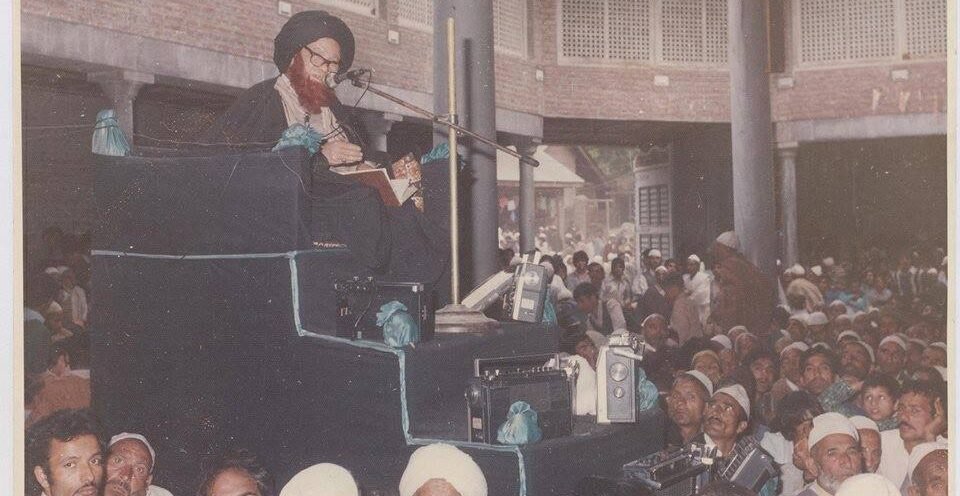
To understand the socio-religious landscape of Kashmir today, one must inevitably look toward Budgam. And to look toward Budgam is to stand in the immense, overarching shadow of one man: Aga Syed Yousuf Al-Moosavi Al-Safavi.
If his son, Aga Syed Mohammad Fazlullah, was the quiet ascetic who preserved the purity of the faith, then Aga Syed Yousuf was the grand architect who built the fortress that housed it. As a historian mapping the timeline of the Moosavi-Safavi lineage in Kashmir, I often categorize the history of the Valley’s Shia community into two distinct eras: before Aga Syed Yousuf, and after him.
He was not merely a cleric; he was an institution. He was the visionary grandfather of Aga Syed Hadi, and it is entirely impossible to fully grasp the work being done at the Anjuman Sharie Shian today without understanding the man who laid its very first stones.
A Valley in Transition: The Rise of a Leader
Born into the revered Aga family, Aga Syed Yousuf inherited a legacy of spiritual leadership. However, the mid-20th century in Kashmir was a period of immense political, social, and economic upheaval. The Shia community, scattered across various districts from Srinagar’s Downtown to the remote villages of North Kashmir, was deeply devoted but institutionally fragmented. They relied heavily on the Aga family for religious guidance, but the rapidly changing world required something more than individual spiritual counsel—it required an organized, systemic defense of their faith, rights, and socio-economic dignity.
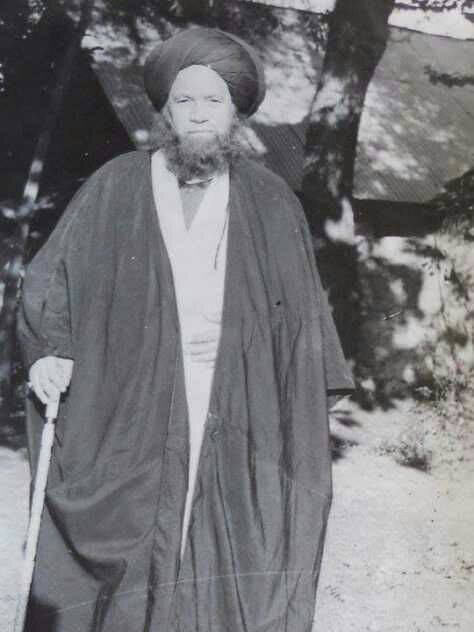
Aga Syed Yousuf recognized this shift with the brilliance of a statesman and the foresight of a true Marja (spiritual authority). He understood that the survival of the community could no longer rely solely on the traditional structures of the past. It needed modern organization rooted in classical Islamic jurisprudence.
The Founding of Anjuman-e-Sharie Shian
This realization birthed his greatest living legacy: the Anjuman-e-Sharie Shian. Founded formally to unify the Shia Muslims of Jammu and Kashmir, the Anjuman was an unprecedented achievement. It was not just a religious body; it was a comprehensive socio-religious government within the community.
Under Aga Syed Yousuf’s direct command, the Anjuman systematized the collection and distribution of Khums and Zakat (Islamic taxes and charity), ensuring that the wealth of the community was actively used to support widows, orphans, and the destitute. He standardized the syllabus for religious education, organized the colossal Muharram processions (Azadari) to ensure they were conducted with profound dignity and safety, and gave the Shia community a unified, powerful voice in the broader socio-political affairs of Kashmir.
The Court of Absolute Justice
Perhaps the most awe-inspiring aspect of Aga Syed Yousuf’s era was the establishment of the Shariat Court (Islamic Judicial Board) in Budgam.
In a time when civil litigation in modern courts was expensive, painfully slow, and often corrupt, Aga Syed Yousuf offered an alternative. His courtyard became the ultimate supreme court for thousands of Kashmiris. People brought to him their most bitter property disputes, complex inheritance issues, and marital conflicts.
His command over Islamic jurisprudence was absolute, but it was his incorruptible sense of justice that made him a legend. Oral histories from the elders of Budgam recount how Aga Syed Yousuf would sit for hours, listening to both sides with piercing attention. When he delivered a verdict, it was final. It was a testament to his towering moral authority that even Sunni Muslims and Kashmiri Pandits would occasionally bring their disputes to his Shariat court, knowing that the “Aga of Budgam” judged strictly by the truth, favoring neither the rich nor the powerful.
The Babul Ilm and the Imambara of Budgam
Aga Syed Yousuf knew that a community that does not educate its youth is destined to fail. To this end, he established Jamia Babul Ilm (The Gateway of Knowledge), a seminary that transformed Budgam into an educational hub. He brought in scholars and established a curriculum that mirrored the great hawzas (seminaries) of Najaf and Qom, ensuring that Kashmiri Shias did not have to travel thousands of miles to receive a high-level Islamic education.
Furthermore, it was under his stewardship that the grand Imambara of Budgam was expanded. He envisioned it not just as a place of mourning during Muharram, but as the beating heart of the community—a place of gathering, learning, and collective strength. Today, when hundreds of thousands gather there, they sit beneath the architectural manifestation of his love for the Ahlulbayt.
The Enduring Shadow
When Aga Syed Yousuf Al-Moosavi Al-Safavi passed away in August 1982, the Valley wept in a way that had rarely been seen before. The funeral procession in Budgam was an ocean of grief, stretching for miles, attended by political leaders, scholars of all sects, and the common laborers he had protected his entire life.
History proves that institutions built entirely on the charisma of one man usually collapse when that man dies. But the Anjuman-e-Sharie Shian did not collapse. It thrived because Aga Syed Yousuf built it on the unshakeable foundations of Taqwa (God-consciousness) and structural integrity.
He passed this monumental weight onto his son, Aga Syed Mohammad Fazlullah, who safeguarded the institution’s spiritual purity, who in turn passed it to his son, Aga Syed Hadi.
When Aga Syed Hadi sits today to resolve a community dispute, or when he utilizes platforms like agasyedhadi.com to reach the global Kashmiri diaspora, he is operating the very machinery engineered by his grandfather. Aga Syed Yousuf took the scattered, brilliant light of Kashmiri Shiism and focused it into a laser. He gave the community its modern identity, its institutions, and its pride. Every recitation of the Quran in the halls of Babul Ilm, every dispute settled amicably in Budgam, and every tear shed for Imam Husayn (AS) under the banner of the Anjuman is a continuing testament to the unmatched vision of Aga Syed Yousuf.