
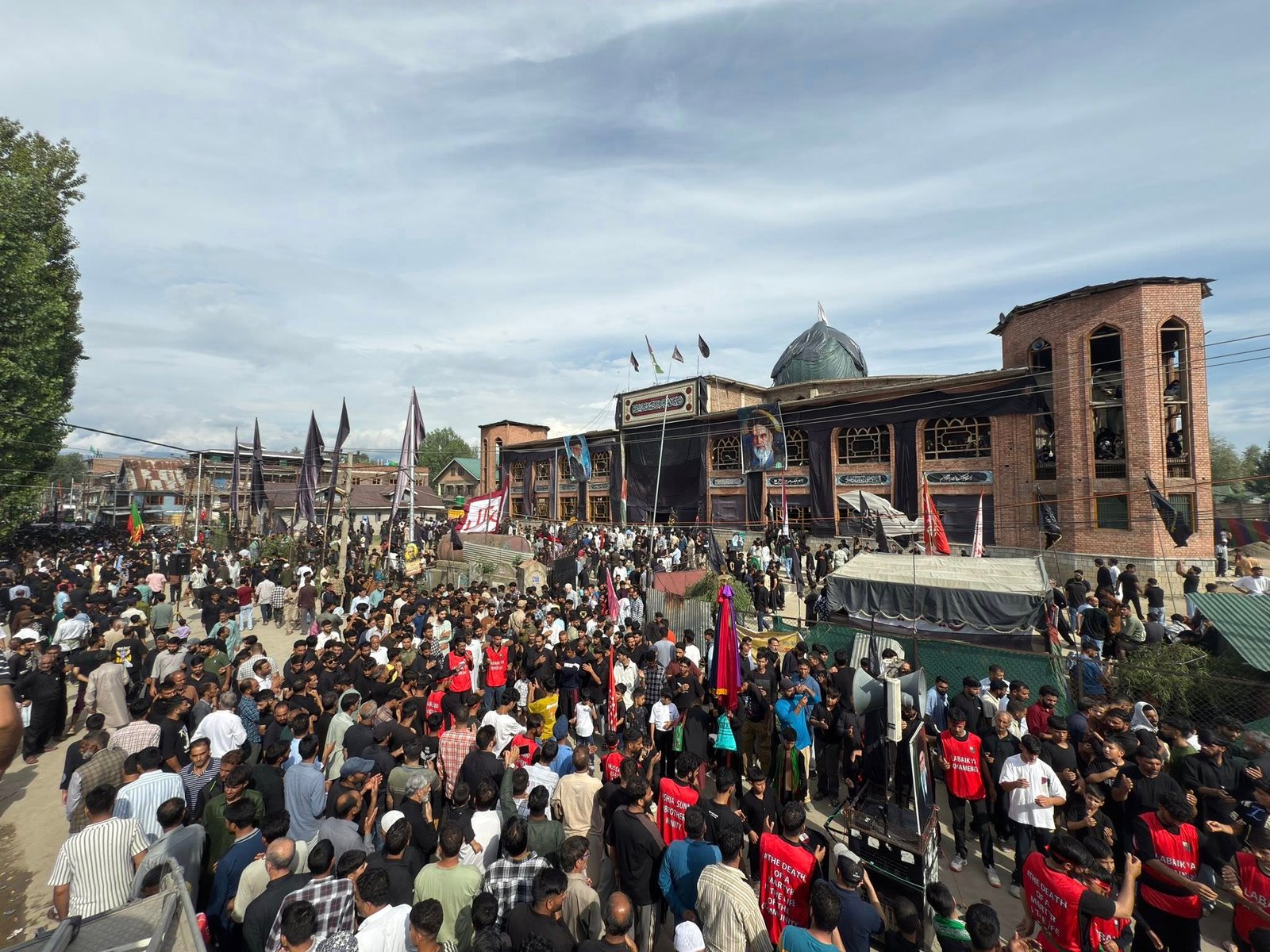
In the cool, crisp air of the Kashmir Valley, as the Islamic month of Safar reaches its twentieth day, a profound transformation takes over the landscape. The streets echo with the rhythmic thumping of chests, the soul-stirring recitation of elegies (Marsiya and Noha), and the fluttering of black banners against the Himalayan sky. This is Arbaeen—also known as Chehlum—the solemn commemoration marking forty days since the tragic martyrdom of Imam Hussain (AS) and his loyal companions at the Battle of Karbala in 61 AH (680 CE).
While the epicenter of Arbaeen is undeniably the holy city of Karbala in Iraq, where millions of pilgrims participate in the world’s largest peaceful annual gathering, the spirit of this mourning transcends geographical boundaries. In Jammu and Kashmir, the spiritual heartbeat of Arbaeen resonates most powerfully in Bemina, guided by the historic organizational framework of the Anjuman-e-Sharie Shiaan.
To understand the sheer magnitude, discipline, and emotional depth of the Arbaeen procession in Bemina today, one must journey through the rich history of Azadari (mourning rituals) in Kashmir, the visionary establishment of Anjuman-e-Sharie Shiaan, and the transformative era of the late religious luminary, Aga Syed Mohammad Fazlullah.
The Theological and Historical Significance of Arbaeen
Before delving into the localized history of Bemina, it is essential to grasp why the fortieth day, Arbaeen, holds such monumental significance in the Islamic tradition. In Arabic, “Arbaeen” translates simply to “forty”. The number forty is deeply embedded in Quranic literature and Islamic theology as a symbol of spiritual maturity, completion, and transition. For instance, Prophet Musa (AS) spent forty nights at Mount Sinai in divine communion, and Prophet Muhammad (PBUH) received his first revelation at the age of forty.
In the context of mourning, Middle Eastern and Islamic cultures historically observe a forty-day period of grief following the passing of a loved one. However, the Arbaeen of Imam Hussain (AS) is uniquely profound. According to historical records, it marks the day when Jabir ibn Abd Allah, a venerable companion of the Prophet Muhammad (PBUH), arrived at the barren plains of Karbala, becoming the first pilgrim to visit the grave of the martyred Imam. It is also the day when the surviving women and children of the Prophet’s household, led by Sayyida Zainab (SA) and Imam Zain-ul-Abideen (AS), returned to Karbala from their agonizing captivity in Damascus to mourn their slain family members.
Today, this historical return is mirrored by millions of devotees worldwide. In Kashmir, where geographical distance prevents most from walking the 80-kilometer route from Najaf to Karbala, the devotees replicate this journey of love locally. The grand procession toward Imambada Bemina has become Kashmir’s very own pilgrimage—a localized testament to an eternal, global grief.
The Roots of Azadari and the Birth of Anjuman-e-Sharie Shiaan
The tradition of mourning Imam Hussain (AS) in Kashmir dates back centuries, significantly influenced by the arrival of the revered Sufi saint and scholar, Mir Shamsuddin Araqi, in the late 15th and early 16th centuries. His teachings deeply embedded the love of the Ahlul-Bayt (the family of the Prophet) within the cultural and spiritual fabric of the Valley. For generations, Kashmiri Shias commemorated Muharram and Safar through local community gatherings, intimate Majalis, and neighborhood processions.
However, as the community grew, there was a pressing need for a unified socio-religious structure to organize these massive gatherings, standardizing Islamic education, and managing community affairs. This need was met by the visionary cleric and leader, Aga Syed Yusuf Al-Moosavi Al-Safavi (1904–1982). A direct descendant of Mir Shamsuddin Araqi, Aga Syed Yusuf returned to Kashmir after completing his advanced Islamic studies in Najaf, Iraq.
Recognizing the fragmented nature of religious administration in the Valley, Aga Syed Yusuf founded the Anjuman-e-Sharie Shiaan in 1946. This organization was established with both religious and socio-political objectives, aiming to uplift the Shia community through education, structured religious courts (Sharie Adalats), and the meticulous organization of Muharram and Arbaeen processions. Aga Syed Yusuf also oversaw the construction of significant religious infrastructure, including the Imambara at Budgam and the Aga Sahib Shrine.
Under the banner of Anjuman-e-Sharie Shiaan, the Arbaeen processions began to take on a more organized, disciplined, and unified form. Rather than scattered, vulnerable gatherings, the community marched with a collective voice, turning the mourning of Imam Hussain (AS) into a powerful display of unity, resilience, and socio-religious identity.
The Era of Aga Syed Mohammad Fazlullah: A Golden Age of Organization
Following the demise of Aga Syed Yusuf in 1982, the legacy of leadership and the monumental task of guiding the Anjuman-e-Sharie Shiaan was taken up by successive generations of the Aga family. A pivotal figure in the modern history of Kashmiri Azadari emerged in the form of his son, Aga Syed Mohammad Fazlullah Al-Moosavi Al-Safavi (1947–2018).
Aga Syed Mohammad Fazlullah’s tenure as a religious cleric and leader marked a golden era for the structural and spiritual expansion of the community. As a member of the World Ahlulbayt Assembly and the chairman of the Ayatollah Yusuf Memorial Trust, he was deeply committed to spreading Islam Naab (pure Islam) and fostering unity within the broader Muslim Ummah in Kashmir.
Navigating the Turbulent Decades
The late 1980s and the 1990s were exceptionally challenging periods in the history of Jammu and Kashmir. With the onset of political turmoil and armed conflict, public gatherings, including religious processions, faced severe restrictions. The traditional 8th Muharram and Ashura processions, which historically passed through the commercial heart of Srinagar, were banned by the authorities citing security concerns—a ban that lasted for over three decades.
During these dark and restrictive times, the community required a safe, expansive, and centralized location to channel their devotion without clashing with the volatile security apparatus. This is where Aga Syed Mohammad Fazlullah’s extraordinary foresight came into play.
The Construction of Imambada Bemina
Realizing that the historic Imambaras and narrow streets of older neighborhoods could no longer safely accommodate the surging numbers of mourners—especially during the massive Arbaeen gatherings—Aga Syed Mohammad Fazlullah spearheaded a monumental architectural project. He envisioned and successfully constructed Kashmir’s largest Imam Bargah in Bemina, located on the outskirts of Srinagar.
Bemina, characterized by its wide roads and expansive spaces, provided the perfect geographic canvas. The Imambada Bemina was designed not merely as a mosque or a mourning hall, but as a sprawling religious complex capable of hosting tens of thousands of devotees simultaneously. Its towering minarets, vast courtyards, and grand halls were built to echo with the names of the martyrs of Karbala.
The Shift of the Arbaeen Epicenter
With the traditional Srinagar routes choked by curfews and bans, Imambada Bemina organically evolved into the primary nerve center for the Arbaeen procession. Under Aga Syed Mohammad Fazlullah’s meticulous organization, Anjuman-e-Sharie Shiaan diverted the major Chehlum processions toward Bemina.
What used to be localized neighborhood walks transformed into a magnificent, centralized march. On the 20th of Safar, processions from Budgam, Magam, Hasanabad, Zadibal, and other far-flung rural districts would converge upon the Bemina bypass, merging into a singular, vast ocean of black-clad mourners. Aga Syed Mohammad Fazlullah ensured that these processions were not just emotional outbursts, but deeply organized, peaceful, and ideologically grounded marches that conveyed a message of anti-oppression and inter-sectarian harmony.
When Aga Syed Mohammad Fazlullah passed away from lung cancer on January 29, 2018, the magnitude of his impact was visible to the world. An estimated 120,000 people attended his funeral procession in Budgam, weeping for the leader who had provided them with a sanctuary of faith in Bemina during the Valley’s toughest years.
The Modern Arbaeen Experience in Bemina
Today, the Arbaeen procession at Imambada Bemina is a breathtaking spectacle of devotion, logistics, and unwavering faith. The organization provided by the Anjuman-e-Sharie Shiaan is evident in every facet of the gathering.
Mawkibs and Sabeels: The Spirit of Hospitality
Drawing direct inspiration from the legendary hospitality witnessed on the road from Najaf to Karbala, the route leading to Imambada Bemina is lined with Mawkibs (hospitality tents) and Sabeels (water and food distribution stalls). Weeks before Arbaeen, local volunteers, youth groups, and committees affiliated with Anjuman-e-Sharie Shiaan begin pooling resources.
On the day of Chehlum, regardless of the harsh Kashmiri weather—be it blistering sun or freezing rain—these volunteers stand on the roadsides distributing Niyaz (consecrated food), hot Kehwa (Kashmiri tea), Tahari (yellow rice), and water to the marching mourners. This act of Khidma (service) is deeply rooted in the ethos of Arbaeen, symbolizing the desire to quench the thirst of Imam Hussain (AS) and his family, who were denied water for three days in Karbala.
The Procession Itself
The Arbaeen day in Bemina begins shortly after the dawn prayers. Men, women, and children dress entirely in black. The processions are highly structured. At the forefront are the Alams (sacred standards) replicating the flag carried by Hazrat Abbas (AS) in Karbala. Following the Alams are rows of chest-beaters (Zanjeer-zani and Sina-zani), moving in perfect synchrony to the heart-wrenching elegies recited by the Noha-khwaans over mobile loudspeakers.
Women also participate in staggering numbers, forming a separate, highly disciplined segment of the procession. Their presence is a direct tribute to Sayyida Zainab (SA), who is celebrated during Arbaeen as the savior of the Karbala narrative. It was Zainab’s eloquent sermons in the courts of the oppressors that ensured the tragedy of Karbala was not buried in the sands of Iraq.
The Climax at Imambada
As the sun begins to dip, the various tributary processions finally converge at the grand Imambada Bemina. The sight is nothing short of majestic. Tens of thousands of hands rise and fall in unison. The air is thick with the fragrance of burning incense and the collective recitation of Ziyarat-e-Arbaeen—a specific salutation directed to Imam Hussain (AS) that reaffirms the believer’s pledge to stand with the oppressed and oppose the tyrants of every age.
Prominent clerics from Anjuman-e-Sharie Shiaan take to the pulpit. The sermons delivered on Arbaeen in Bemina are rarely limited to historical recounting. True to the legacy of Aga Syed Mohammad Fazlullah, these Majalis are platforms for socio-political awakening. Scholars address contemporary issues, advocating for justice, education, global human rights, and the absolute necessity of unity among all Muslims—both Shia and Sunni. In fact, it is a hallmark of the Bemina procession that many Sunni brethren participate, operating Sabeels and standing shoulder-to-shoulder in mourning the Prophet’s beloved grandson, reflecting the deep-seated Kashmiriyat and Islamic brotherhood.
The Arbaeen procession in Bemina is much more than an annual religious ritual; it is the living, breathing heart of Kashmiri Shia identity. It is a historical continuum that connects the tragic sands of Karbala in 61 AH to the lush, conflict-torn valleys of Kashmir in the 21st century.
Through the foresight of leaders like Aga Syed Yusuf Al-Moosavi Al-Safavi, who institutionalized the grief through Anjuman-e-Sharie Shiaan, and the tireless dedication of Aga Syed Mohammad Fazlullah, who built the monumental Imambada Bemina as a fortress for this devotion, the community has ensured that the message of Imam Hussain (AS) remains indestructible.
As the millions gather in Iraq, the tens of thousands who march in Bemina prove a profound truth: one does not need to be physically present in Karbala to answer the call of Imam Hussain (AS). By keeping the tradition of Arbaeen alive with such staggering discipline, hospitality, and theological clarity, the organizers and devotees in Bemina ensure that the banner of truth, justice, and unwavering faith remains flying high in the shadow of the Himalayas.
A New Era of Awakening: The Leadership of Aga Syed Mohammad Hadi
The monumental legacy of Anjuman-e-Sharie Shiaan and the spiritual sanctity of Imambada Bemina did not pause with the passing of Aga Syed Mohammad Fazlullah in 2018. The mantle of leadership, carrying the heavy responsibility of guiding thousands of believers through faith, education, and social reform, naturally transitioned to his son and successor, Aga Syed Mohammad Hadi Al-Moosavi Al-Safavi.
Today, under the stewardship of Aga Syed Mohammad Hadi, the Arbaeen procession and the broader Azadari culture in Kashmir have entered a dynamic new phase. Known for his intellectual depth, spiritual eloquence, and modern socio-religious vision, Aga Syed Hadi stands as a pivotal contemporary cleric who masterfully bridges the gap between traditional Islamic scholarship and the pressing needs of modernity.
Intellectual and Spiritual Revival
When Aga Syed Mohammad Hadi takes to the pulpit at Imambada Bemina on the day of Arbaeen, his sermons (Majalis) transcend traditional historical recounting. He utilizes the tragedy of Karbala as an active framework for addressing contemporary social, moral, and political crises. His speeches are intellectually rich and socially conscious, emphasizing that mourning Imam Hussain (AS) is incomplete without adopting the Imam’s principles of justice, human dignity, and resistance against all forms of modern tyranny.
For the youth of Kashmir, who often navigate a complex socio-political landscape, Aga Syed Mohammad Hadi has emerged as a crucial anchor. He consistently urges the younger generation to not only participate in chest-beating (Matam) but to intellectualize their grief—to become educated, ethically upright, and socially responsible citizens who actively contribute to society.
Modernizing Azadari: Humanitarian and Social Initiatives
One of the most defining characteristics of Aga Syed Mohammad Hadi’s leadership during the Arbaeen and Muharram periods is the integration of massive humanitarian initiatives into the fabric of mourning. While the Sabeels (water stalls) and Mawkibs (food tents) continue to expand under the Anjuman Sharie banner, there has been a profound push toward community welfare, healthcare, and education.
Under his guidance, Arbaeen in Bemina has become synonymous with large-scale blood donation drives. By encouraging mourners to donate blood, Aga Syed Mohammad Hadi has successfully institutionalized a practice where the sorrow for the blood spilled in Karbala is transformed into a life-saving mechanism for the local population, irrespective of religious or sectarian backgrounds.
Furthermore, his leadership emphasizes the expansion of educational institutions. The Aayatullah Yousuf Memorial Educational Institute (AYMEI), which operates under the organization’s umbrella, is a testament to his belief that true empowerment for the community lies in robust education. During the Arbaeen gatherings, the message of educational upliftment is reiterated, reflecting Imam Hussain’s (AS) core mission to reform and awaken the conscience of society.
Maintaining the Sanctuary of Bemina
Imambada Bemina, the crown jewel of his father’s structural legacy, continues to thrive and expand under Aga Syed Mohammad Hadi’s supervision. The logistical management of the Arbaeen procession—coordinating tens of thousands of mourners, managing traffic, ensuring the safety of women and children, and organizing the grand congregation for prayers and sermons—is executed with remarkable precision by the youth committees and volunteers of Anjuman-e-Sharie Shiaan.
Under Aga Syed Mohammad Hadi’s present leadership, the message echoing from Bemina on Arbaeen remains clear and undiluted. It is a message that honors the sacrifices of the past while actively building a spiritually resilient, highly educated, and socially responsible community for the future. Through his guidance, the 40th day of mourning is not just a conclusion of grief, but an annual renewal of a community’s pledge to truth and justice.
Latest Majlis e Aza by Aga Syed Mohammad Hadi
Updated References
- Official Website of Aga Syed Mohammad Hadi Kashmiri. Biography, Social Work, and Speeches. (agasyedhadi.com)
- Aga Syed Mohammad Hadi – Wikipedia profile and historical succession.
- Contributions of Aga Syed Mohammad Fazlullah and transition of leadership in Anjuman-e-Sharie Shiaan. Ashoora Muharram Majlis – Imam Hussain Research.
- To hear a firsthand sermon from these gatherings, you can watch this Majlis-e-Arbaeen by Aga Syed Mohammad Hadi in Bemina. This video captures the profound spiritual atmosphere and the intellectual depth of the addresses delivered at Imambada Bemina during the Arbaeen commemoration.
- Aga Syed Mohammad Fazlullah Al-Moosavi Al-Safavi (1947-2018) biography and contributions. Ashoora Muharram Majlis – Imam Hussain Research.
- Aga Syed Yusuf Al-Moosavi Al-Safavi biography, founding of Anjuman-e-Sharie Shiyan, and historical context. Wikipedia.
- Aga Sahib Shrine, Ziyarat e Sarkaar, and historical burials in Budgam. Wikipedia.
- The theological significance of the number 40 in Islam and the tradition of Arbaeen. The Muslim Vibe.
- Arba’in pilgrimage, the historic return of Jabir ibn Abd Allah, and the global gathering at Karbala. Wikipedia.,
- The tradition of Mawkibs and global participation in the Arbaeen walk. Shafaqna India.
Historical context of pilgrimage on foot and its revival post-Saddam Hussein. World Council of Shia Centers.