
“This blessing is not achieved by the strength of arms, unless bestowed by the Forgiving Lord.”
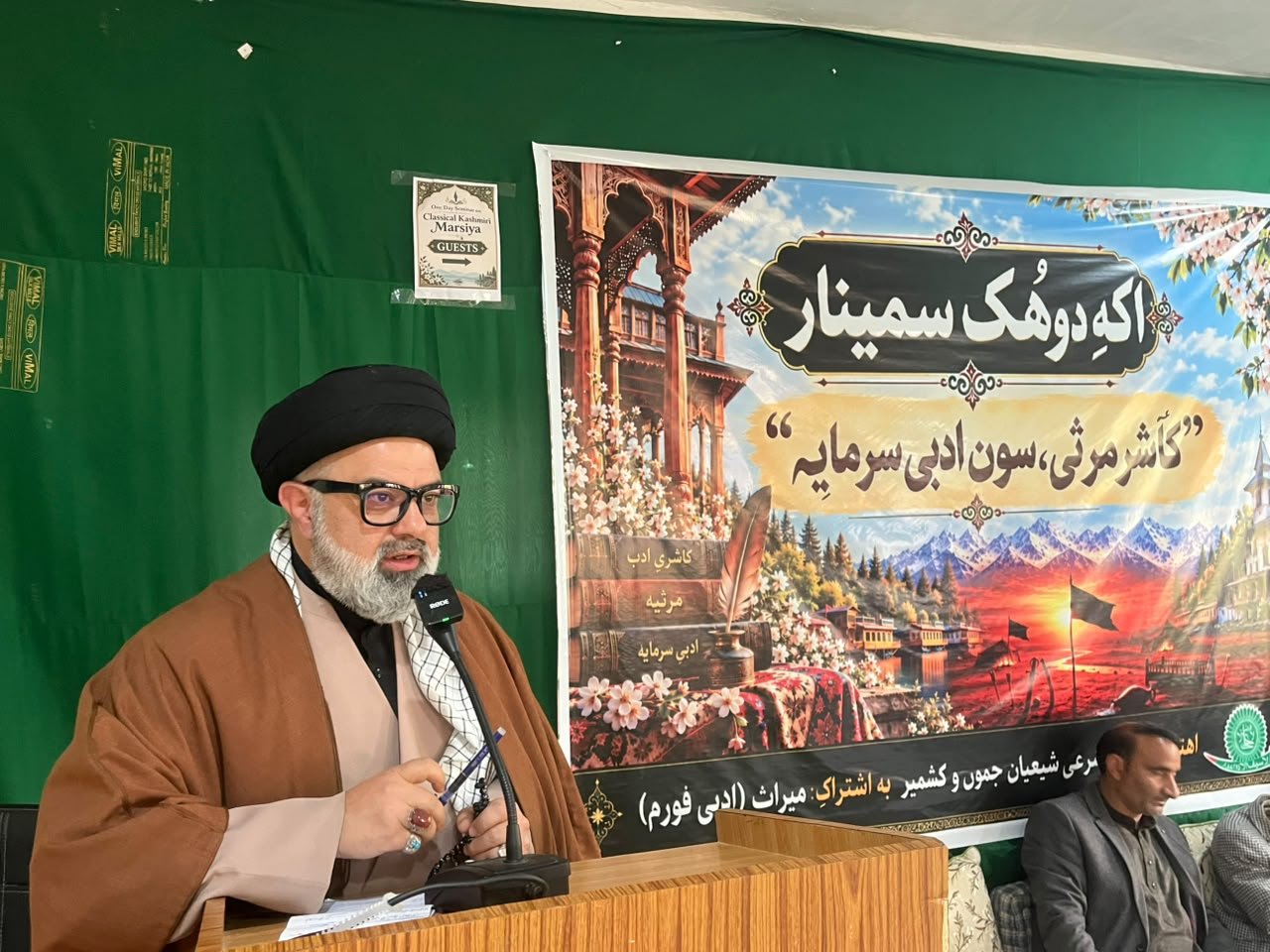
This timeless Persian proverb perfectly encapsulates the divine grace and collective devotion that permeated the air at Dar-ul-Ali (r.a.) in Mirgund, Budgam, on November 1, 2026. On this historic day, a landmark academic and literary conference titled “Kashur Marsiya, Son Adabi Miras” (Kashmiri Marsiya, Our Literary Heritage) was convened. Organized through a visionary collaboration between Anjuman Shari Shian Jammu & Kashmir (Shariat Abad Yusuf (r.a.) Abad Budgam) and the cultural preservation organization ‘Miras’, the event marked a critical milestone in recognizing, analyzing, and safeguarding the profound legacy of elegiac poetry in the Kashmir Valley.
Graced by esteemed religious scholars, distinguished academics, and passionate researchers, the conference featured Hujjat-ul-Islam wal-Muslimin Aga Syed Mohammad Hadi Al-Moosavi Al-Safavi, President of Anjuman Shari Shian, and Professor Dr. Abid Gulzar as the chief guests. What unfolded over the course of the day was not merely a retrospective look at poetry, but a deep, intellectual exploration of how the Kashmiri Marsiya has served as the beating heart of faith, language, and cultural resilience for centuries.
The Genesis of Marsiya in the Valley of Saints
To understand the magnitude of this conference, one must first understand the intrinsic relationship between the people of Kashmir and the tradition of Marsiya. The word Marsiya stems from the Arabic root Ritha, meaning a great tragedy or elegy. While its historical origins are firmly rooted in the scorching sands of Karbala, mourning the unparalleled sacrifices of Imam Hussain (a.s.) and his devoted companions, its journey to the lush, mountainous terrain of Kashmir birthed a unique literary phenomenon.
When the message of the Ahlulbayt (a.s.) reached Kashmir, it did not merely translate into a new theological understanding; it seeped into the very linguistic and cultural fabric of the region. The Kashmiri Marsiya emerged as a localized, profoundly emotional vehicle for expressing global grief. It intertwined the sophisticated spiritual concepts of Wilayat (divine authority), martyrdom, and justice with the familiar, rhythmic cadences of the Koshur language.
Scholars at the conference presented illuminating research papers detailing this evolution. They highlighted how early Kashmiri Marsiya writers transcended mere translation of Persian or Arabic elegies. Instead, they utilized native metaphors, local imagery, and indigenous poetic meters to make the tragedy of Karbala intimately relatable to the Kashmiri populace. The grief of the household of the Prophet (PBUH) was narrated in a tongue that the common man spoke in his home, his fields, and his markets, transforming the Marsiya into a living, breathing cultural artifact.
The Intersection of Faith and Literature



During the conference, the academic sessions illuminated the multi-dimensional utility of the Kashmiri Marsiya. It is a genre that defies simple categorization. As several researchers meticulously pointed out in their dissertations, the Marsiya in Kashmir is simultaneously an act of worship, an instrument of social justice, a chronicle of history, and a masterpiece of linguistic art.
From a linguistic standpoint, the Marsiya has played an indispensable role in preserving the classical vocabulary and grammatical purity of the Kashmiri language. In eras where foreign languages dominated the courts and administrative corridors of the Valley, it was the nocturnal gatherings of Majalis and the recitation of Marsiyas that kept the rich, indigenous vocabulary alive. The poets who penned these elegies were masters of language, employing complex allegories, profound similes, and rhythmic structures that pushed the boundaries of Kashmiri literature.
From a religious perspective, the Marsiya functions as an emotional anchor. The chief guests and paper presenters collectively emphasized that mourning for Imam Hussain (a.s.) is not a static ritual; it is a dynamic, pedagogical tool. The Kashmiri Marsiya teaches theology, morality, and resilience. It articulates the bravery of Hazrat Abbas (a.s.), the patience of Bibi Zainab (s.a.), and the innocence of Hazrat Ali Asghar (a.s.) in verses that have the power to melt the hardest of hearts. By analyzing these texts, the conference underscored that the literary heritage of Marsiya is, in fact, a sophisticated curriculum of human empathy and divine love.
The Presidential Address: Aga Syed Mohammad Hadi’s Vision
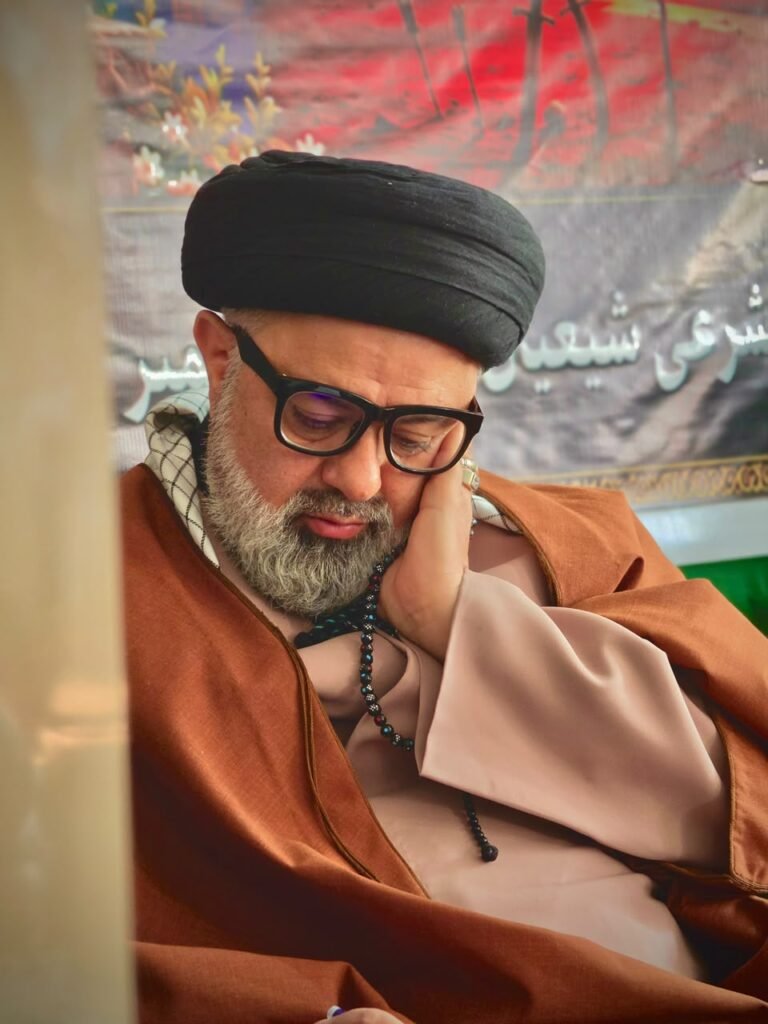
A defining moment of the conference was the profound address delivered by Hujjat-ul-Islam wal-Muslimin Aga Syed Mohammad Hadi Al-Moosavi Al-Safavi. His discourse provided a vital bridge between the historical preservation of literature and the contemporary spiritual needs of the community.
Aga Syed Hadi articulated that our inheritance—our Miras—is not limited to physical properties or grand architecture; our truest inheritance is the ideological and spiritual literature passed down by our ancestors. He noted that the poets of the past did not write Marsiyas for fame or worldly gain; their ink was fueled by tears, and their parchment was their devotion to the Prophet’s household. Therefore, honoring the Kashmiri Marsiya is synonymous with honoring the purest intentions of those who kept the message of Karbala alive during the darkest periods of history.
He further elaborated on the necessity of integrating this literary heritage into the modern educational framework. In an age dominated by digital distraction and cultural alienation, Aga Syed Hadi emphasized that connecting the youth with the Kashmiri Marsiya is a powerful antidote. It roots them in their identity, provides them with a moral compass, and instills a sense of pride in their native language. His address was a clarion call to action: to digitize ancient manuscripts, to encourage contemporary poets to write in the Kashur language, and to ensure that the recitation of these elegies continues to resonate in homes and Imambargahs across the Valley.
Academic Rigor: Insights from Professor Dr. Abid Gulzar
Complementing the spiritual discourse, Professor Dr. Abid Gulzar brought a rigorous academic lens to the proceedings. His participation underscored the necessity of bringing Marsiya out of the exclusive domain of religious gatherings and into the halls of academia.
Dr. Gulzar and the cohort of researchers highlighted the urgent need for critical editions of classical Kashmiri Marsiyas. Many of these masterpieces exist only in oral traditions or fragile, decaying manuscripts hidden in private collections. The researchers presented alarming data regarding the potential loss of this literature if immediate, scientific preservation methods are not adopted.
The academic discussions delved into the structural brilliance of the Kashmiri Marsiya, comparing its Musaddas (six-line stanza) and Marthiya forms with those of Urdu and Persian giants like Mir Anis and Mirza Dabeer. However, it was firmly established that the Kashmiri Marsiya holds its own unique space, characterized by its deep mystical (Sufiyana) undertones and its stark, visceral imagery of the Kashmiri landscape seamlessly blended with the desert of Nineveh. The researchers successfully proved that analyzing this poetry yields invaluable insights into the socio-economic and political history of Kashmir itself, as the poets often subtly wove the struggles of their own times into the eternal struggle of Karbala.
The Cultural Imperative: Why We Must Preserve This Heritage
The overarching theme that echoed throughout Dar-ul-Ali in Mirgund was one of immense responsibility. The title of the conference, “Kashur Marsiya, Son Adabi Miras,” was not just a statement of fact; it was a manifesto.
The discussions revealed that the erosion of the Kashmiri language among the younger generation poses a direct threat to the survival of this literary tradition. When a language fades, the cultural and religious memory embedded within it also begins to wither. The Marsiya is the repository of the Kashmiri Shia community’s collective memory. If the youth cannot understand the profound vocabulary of their ancestors’ grief, they lose a vital connection to their spiritual lineage.
Therefore, the conference served as a vital intervention. It highlighted that the preservation of Marsiya is inextricably linked to the preservation of the Kashmiri language itself. By promoting this elegiac poetry, organizations like Anjuman Shari Shian and ‘Miras’ are simultaneously championing a linguistic revival. They are demonstrating that the Kashmiri language is not just a vernacular of the past, but a robust, deeply expressive medium fully capable of conveying the highest pinnacles of philosophical and theological thought.
Resolutions and the Path Forward
As the sun began to set over Budgam, the conference moved towards its concluding session, transitioning from reflection to strategic planning. The culmination of the event was marked by a strong, unanimous consensus among the scholars, clerics, and attendees on several critical resolutions.
First and foremost was the commitment to continuity. It was emphatically agreed that this conference must not be a singular, isolated event. There is a pressing need to organize a sustained series of seminars, workshops, and academic symposia dedicated to various facets of Shiite Islamic literature in Kashmir.
Secondly, a significant emphasis was placed on documentation and digitization. Calls were made to establish a centralized, accessible archive where ancient Marsiya manuscripts could be cataloged, restored, and digitized for global access. This initiative aims to protect these fragile documents from the ravages of time and make them available to researchers, linguists, and devotees worldwide.
Furthermore, there was a collective pledge to encourage the modern generation of Kashmiri poets to take up the mantle. The tragedy of Karbala is eternal, and so too must be the literature that honors it. By fostering contemporary talent, the community ensures that the Kashmiri Marsiya remains a living, evolving art form rather than a static relic of the past.
A Legacy of Tears and Triumph
The “Kashur Marsiya, Son Adabi Miras” conference was, in essence, a testament to the enduring power of words fueled by faith. It proved that the elegy in Kashmir is much more than a song of sorrow; it is a soaring anthem of resistance against the erasure of identity, language, and divine truth.
Through the dedicated efforts of Anjuman Shari Shian, ‘Miras’, and visionary leaders like Aga Syed Mohammad Hadi Al-Moosavi Al-Safavi, the community has taken a monumental step toward reclaiming and celebrating its intellectual inheritance. The event at Dar-ul-Ali (r.a.), Mirgund, will undoubtedly be remembered as a watershed moment in the cultural history of Jammu and Kashmir—a day when scholars and clerics united to declare that the literary tears shed for Imam Hussain (a.s.) in the Kashmiri tongue will never be forgotten, but will be preserved as the most precious jewels of our collective heritage.
As we look to the future, the responsibility now falls upon every individual, every household, and every educational institution in the Valley to embrace this heritage. We must read the Marsiyas of our ancestors, understand their profound depths, and ensure that the melodious, heartbreaking, and fiercely beautiful tradition of the Kashmiri elegy is passed down, pristine and powerful, to the generations yet to come.